
Dumbbell Hip Thrust
The dumbbell hip thrust is a beginner compound exercise that mainly works the glutes, with help from the hamstrings, quadriceps and abs.
A glute-focused exercise that drives the hips upward against a dumbbell. It loads the glutes hardest at full hip extension.
Suggested volume: 3–4 sets of 10–15 reps
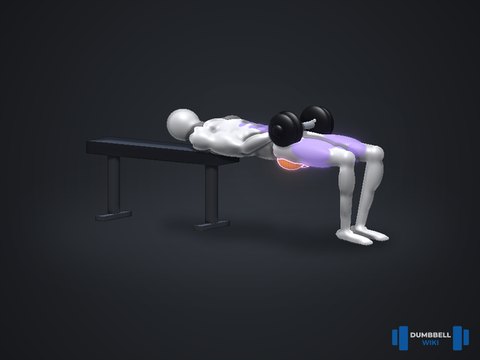 Coming soon3D exercise demo
Purpose of the dumbbell hip thrust
The hip thrust is one of the most effective exercises for isolating the gluteus maximus. With your upper back on a bench and a dumbbell resting on your hips, you drive the hips up until your body forms a straight line from shoulders to knees. Resistance peaks at full hip extension, where the glutes are most contracted.
How to do the dumbbell hip thrust: step by step
- Sit on the floor with your upper back against the long edge of a bench and a dumbbell resting across your hips.
- Bend your knees and plant your feet flat, about hip-width apart.
- Hold the dumbbell in place with both hands, brace your core and tuck your chin slightly.
- Drive through your heels to lift your hips until your thighs and torso are level and your shins are vertical.
- Squeeze your glutes hard at the top for a second, then lower your hips under control and repeat.
Dumbbell Hip Thrust benefits
- Strongly targets the gluteus maximus
- Builds hip-extension power for sprinting and jumping
- Low stress on the lower back compared with many hip exercises
- Easy to progress with heavier dumbbells or pauses
Common dumbbell hip thrust mistakes
- Arching the lower back at the top instead of finishing with the glutes
- Feet too far forward or too close, which shifts work away from the glutes
- Pushing through the toes instead of the heels
Dumbbell Hip Thrust progressions
- Harder: once you own the dumbbell hip thrust, progress to the dumbbell reverse lunge and dumbbell single-leg hip thrust.
- See all dumbbell glute exercises.
Dumbbell Hip Thrust FAQs
Hip thrust vs glute bridge?
A glute bridge is done with the shoulders on the floor, which gives a shorter range of motion. The hip thrust, with the back on a bench, allows a greater range and heavier loading.