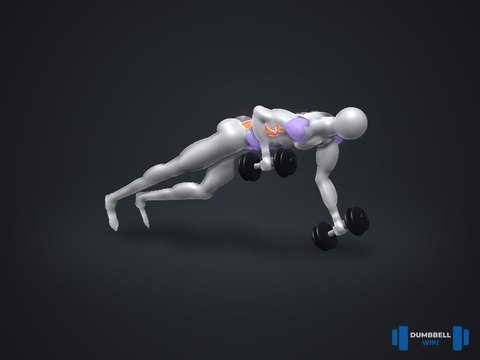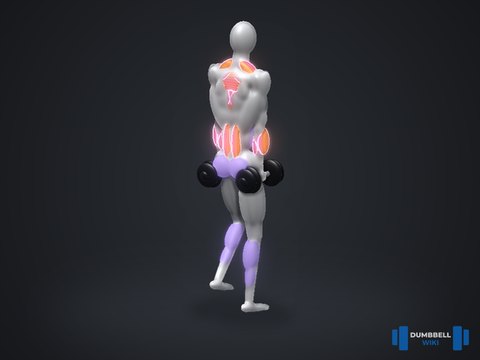

Dumbbell Bent-Over Row
The dumbbell bent-over row is a beginner compound exercise that mainly works the lats, trapezius and lower back, with help from the biceps and shoulders.
A hip-hinge pulling exercise that builds a thick, strong back. It works the lats, mid-back and rear shoulders.
Also known as: Bent-Over Dumbbell Row, Two-Arm Dumbbell Row, Neutral-Grip Dumbbell Row
Suggested volume: 3–4 sets of 8–12 reps
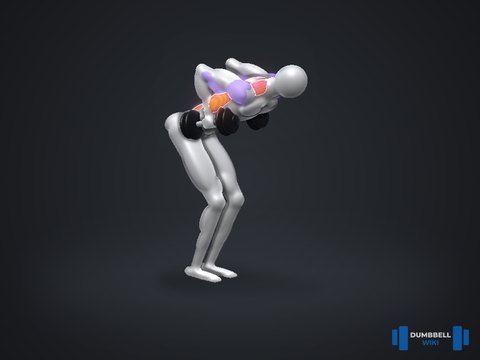 Coming soon3D exercise demo
Purpose of the dumbbell bent-over row
The bent-over row is a staple back exercise. You hinge forward and pull the dumbbells toward your hips. It trains the lats, the middle trapezius and rhomboids, and the rear deltoids, while the lower back and hamstrings work hard to hold the hinged position. It balances pressing work and supports good posture.
How to do the dumbbell bent-over row: step by step
- Hold a dumbbell in each hand with palms facing each other. Stand with feet hip-width apart.
- Soften your knees and hinge at the hips, pushing them back until your torso is at roughly 45° or lower. Keep your back flat.
- Let the dumbbells hang straight down from your shoulders.
- Pull the dumbbells toward your lower ribs/hips, driving your elbows back and squeezing your shoulder blades together.
- Lower the dumbbells under control until your arms are straight, keeping your torso still, and repeat.
Dumbbell Bent-Over Row benefits
- Builds back thickness and width
- Balances chest and shoulder pressing to support shoulder health
- Strengthens the lower back in an isometric hold
- Improves grip and biceps strength
Common dumbbell bent-over row mistakes
- Rounding the lower back
- Standing up more with each rep to swing the weight
- Pulling with the arms only instead of driving the elbows back
Dumbbell Bent-Over Row progressions
- Harder: once you own the dumbbell bent-over row, progress to the dumbbell meadows row and dumbbell pullover.
- See all dumbbell back exercises.
Dumbbell Bent-Over Row FAQs
Should I use one arm or two?
Two-arm rows also train the lower back to hold the hinge. One-arm rows supported on a bench let you go heavier with less lower-back fatigue. Both are excellent.